
|
0.6.0
|
|
|
0.6.0
|
3D Dissolution of a gas bubble in a liquide phase
3D Dissolution of a gas bubble in a liquide phase
This test case presented by [1], [2] describes the dissolution of a gas bubble
We consider a cubic computational domain of side length \(L = 30 \times L_{\text{ref}}\). Given the high computational cost of three-dimensional simulations, a composite mesh is employed, consisting of two distinct regions:
(i) The first region, centered on the sphere, is composed of uniform cells. It extends up to a distance \(l_u = 4 \times L_{\text{ref}}\) from the center, in order to accurately capture the local dissolution phenomena. This zone is discretized with a fine resolution corresponding to 50 cells per sphere diameter \(D\).
(ii) The second region covers the remainder of the domain. It uses a non-uniform mesh in which the spatial step increases exponentially as the distance from the bubble increases. The objective is to limit the total number of cells while maintaining sufficient resolution in the vicinity of the bubble.
The initial radius of the sphere is \(R = 5\times 10^{-3}~\text{m}\).
The properties of the system are:
| phases | \(\rho~\left[\text{kg}.\text{m}^{-3}\right]\) | \(\mu~\left[\text{N.s}.\text{m}^{-2}\right]\) |
|---|---|---|
| liquid | 1000 | \(1.05\times 10^{-3}\) |
| gas | 1 | \(1.46\times 10^{-5}\) |
The simulation is performed with a henry's coefficient \(H=0.2\) for a diffusion coefficient: \(D_{A,l} = 2 \times 10^{-5}\,\mathrm{m^2\,s^{-1}}\).
Neumann conditions are applied on all the boundaries.
Initialy, the species concentration in liquid phase is equal to \(0\) while the concentration in the gas phase is equal to \(1\).
The results for both methods unshifted and shifted are the same. Figure 1 presents a comparison between the interface displacement kinetics obtained numerically and those predicted analytically.
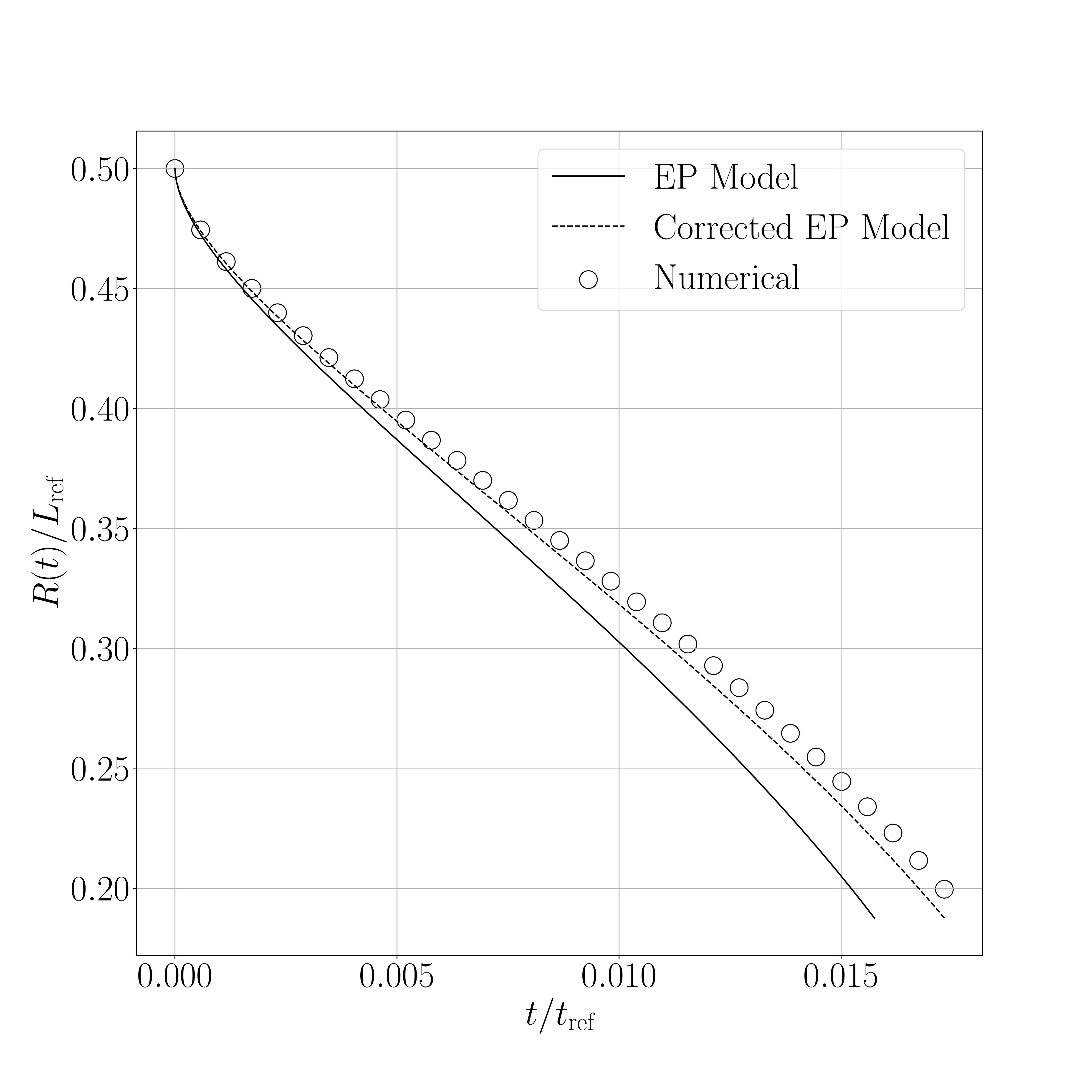
The obtained results show a good agreement between numerical and analytical solutions.
[1] Duda, J., & Vrentas, J. (1971). Heat or mass transfer-controlled dissolution of an isolated sphere. International Journal of Heat and Mass Transfer, 14(3), 395-407. https://doi.org/https://doi.org/10.1016/0017-9310(71)90159-1 [2] Gennari, G., Jefferson-Loveday, R., & Pickering, S. J. (2022). A phase-change model for diffusion-driven mass transfer problems in incompressible two-phase flows. Chemical Engineering Science, 259, 117791. https://doi.org/10.1016/j.ces.2022.117791
 1.12.0