
|
0.6.0
|
|
|
0.6.0
|
Validation of the steady flows past a sphere at various Reynolds numbers \(Re=50, 100\) and \(150\).
Validation of the steady flows past a sphere at various Reynolds numbers \(Re=50, 100\) and \(150\).
The following numerical simulations validate the immersed boundary methods on steady flows past a sphere at various Reynolds numbers \(Re=50, 100\) and \(150\) (see [1,2] for more details).
A sphere of diameter \(D=1.0\) is placed at \((x,y,z)=(12.5,8.5,8.5)D\) of a computational domain \(Ω=[31.25D, 17D, 17D]\). Appropriate Dirichlet and Neumann IBCs for u and pressure increment, respectively, for no slip condition at the immersed boundaries are chosen. The boundary conditions for the domain boundaries for velocity are a uniform flow \(u=(1.0,0.0,0.0)\) at the inlet, zero-gradient at the outlet and slip boundary condition for the remaining domain boundaries, while pressure increment has Dirichlet boundary conditions of zero for the outlet and zero normal gradient for the remaining domain boundaries.
A non-uniform rectilinear grid of size \(275×1502\) with a uniform Cartesian grid of size \(160×802\) for the region around the sphere enclosed by \([−1.0, −1.0, −1.0]\) and \([3.0, 1.0, 1.0]\) is used for all Reynolds numbers considered.
Implicit discretization is used. The second order centered advection scheme is used. We focus on the second order image point linear square shift ghost-cell immersed boundary method (LIS) [1].
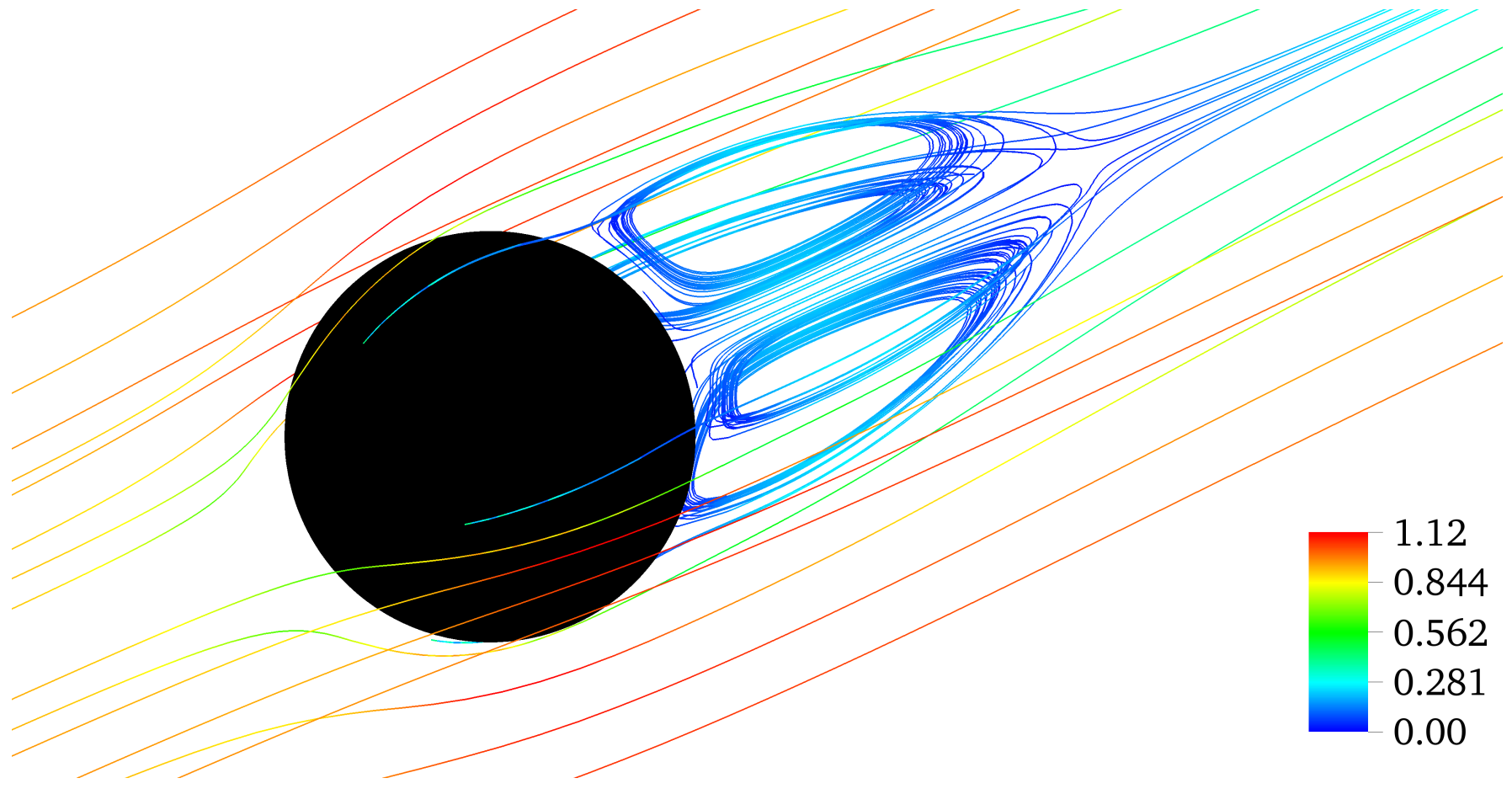
Figure 1 shows the streamlines coloured by velocity magnitude for steady laminar flow past a sphere immersed boundary at Re=150.
Next Table shows the good agreement in the coefficient of drag \(C_D\) and the non-dimensional wake bubble length \(L_w/D\), where \(L_w\) is the wake bubble length. Although the results are for the LIS method, similar results are obtained with the L method.
| Reynolds number | 50 | 50 | 100 | 100 | 150 | 150 |
|---|---|---|---|---|---|---|
| Mittal [2] | 1.57 | 0.44 | 1.09 | 0.87 | - | - |
| Johnson and Pael [3] | 1.57 | 0.40 | 1.08 | 0.86 | 0.90 | 1.20 |
| Marella et al. [4] | 1.56 | 0.39 | 1.06 | 0.90 | 0.85 | 1.19 |
| Notus (LIS method) | 1.59 | 0.40 | 1.09 | 0.86 | 0.89 | 1.18 |
[1] A. M. D. Jost and S. Glockner, Direct forcing immersed boundary methods: Improvements to the Ghost Node Method, Journal of Computational Physics, volume 438, 110371, 2021.
[2] R. Mittal, “A fourier–chebyshev spectral collocation method for simulating flow past spheres and spheroids,” International journal for numerical methods in fluids, vol. 30, no. 7, pp. 921– 937, 1999.
[3] T. Johnson and V. Patel, “Flow past a sphere up to a reynolds number of 300,” Journal of Fluid Mechanics, vol. 378, pp. 19–70, 1999.
[4] S. Marella, S. Krishnan, H. Liu, and H. Udaykumar, “Sharp interface cartesian grid method i: an easily implemented technique for 3d moving boundary computations,” Journal of Computational Physics, vol. 210, no. 1, pp. 1–31, 2005.
 1.12.0