
|
0.6.0
|
|
|
0.6.0
|
Validation of the heated flow around a circular cylinder.
Validation of the heated flow around a circular cylinder.
These validation cases study the steady laminar flow past an isothermal and an isoflux heated circular cylinder at \(Re=20\) and Prandtl number \(Pr=0.70\) with a diameter \(D=1.0\) placed at \((x,y)=(15,11)D\) of a computational domain \(Ω=[37.5D, 22D]\). These test cases were studied in [1] in the context of improving second-order ghost-cell immersed boundary methods.
Domain boundary conditions are uniform inlet of velocity \((u_\inf, 0)^T\) at the left boundary, slip at top and bottom boundaries, and Neumann at the right boundary.
The boundary conditions for temperature at the immersed boundary is uniform temperature \(T=1\) or uniform heat flux \(∂T /∂n=1\) for the isothermal and isoflux cases, respectively, while a uniform temperature T=0 is applied at the inlet and zero gradient ∂T /∂n is used for the remaining domain boundaries.
Non-uniform rectilinear grids of sizes \(880×480\) with uniform Cartesian grid of sizes \(640×320\) for the region around the circular cylinder enclosed by \([−1.0, −1.0]\) and \([3.0, 1.0]\) are used. Implicit second order scheme are used. The image point linear square shift LIS immersed boundary method is used (see [1]).
| Label |
|---|
| cylinder_forced_convection_2D.nts |
The next table shows good agreement with the literature for the average Nusselt number, while Figure 1 shows good agreement in the distribution of the local Nusselt number along the surface of the heated circular cylinder.
| Isothermal | Isoflux | |
|---|---|---|
| Luo et al. [2] | 2.4336 | 2.7850 |
| Zhang et al. [3] | 2.47 | 2.75 |
| Bharti et al. [4] | 2.4653 | 2.7788 |
| Dennis et al. [5] | 2.5216 | — |
| Lange et al. [6] | 2.4087 | — |
| Soares et al. [7] | 2.4300 | — |
| Ahmad and Qureshi [8] | — | 2.6620 |
| Current(LIS) | 2.4272 | 2.7916 |
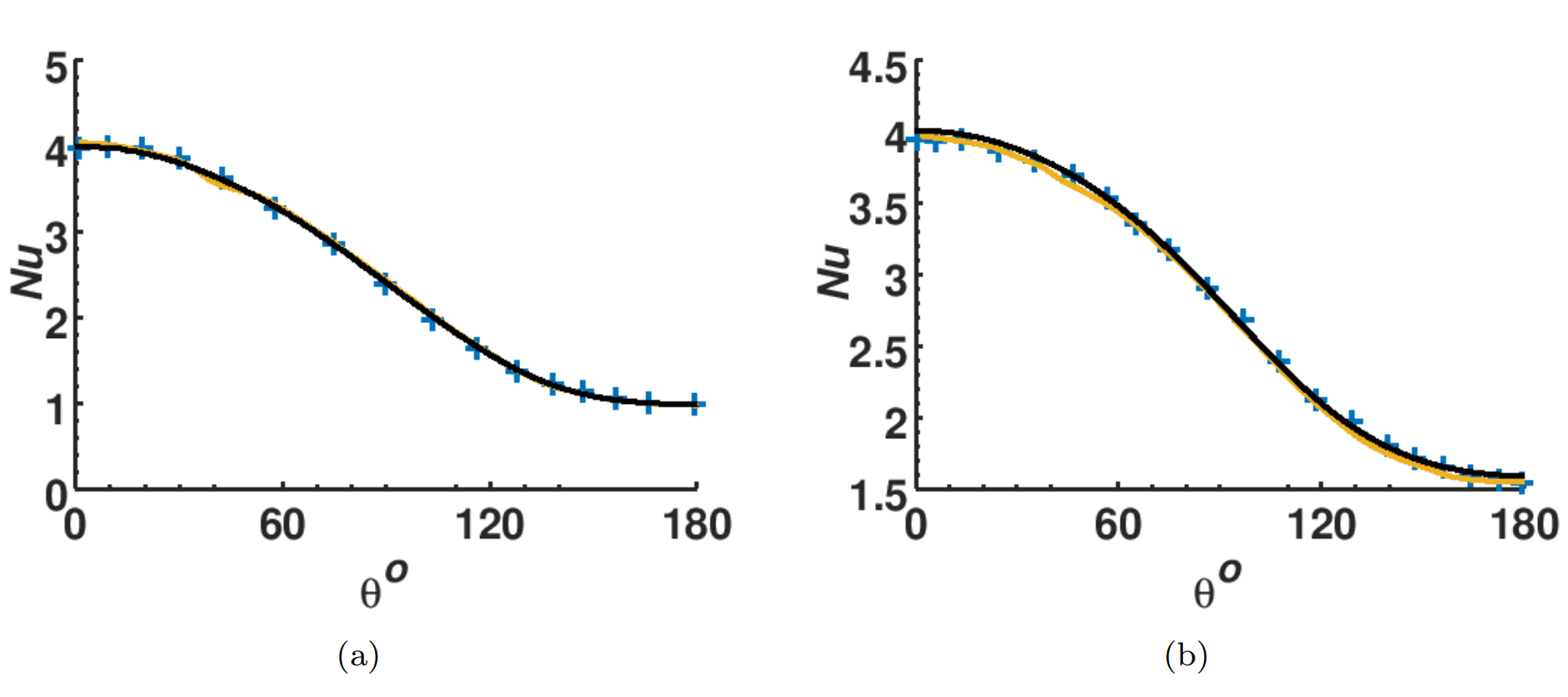
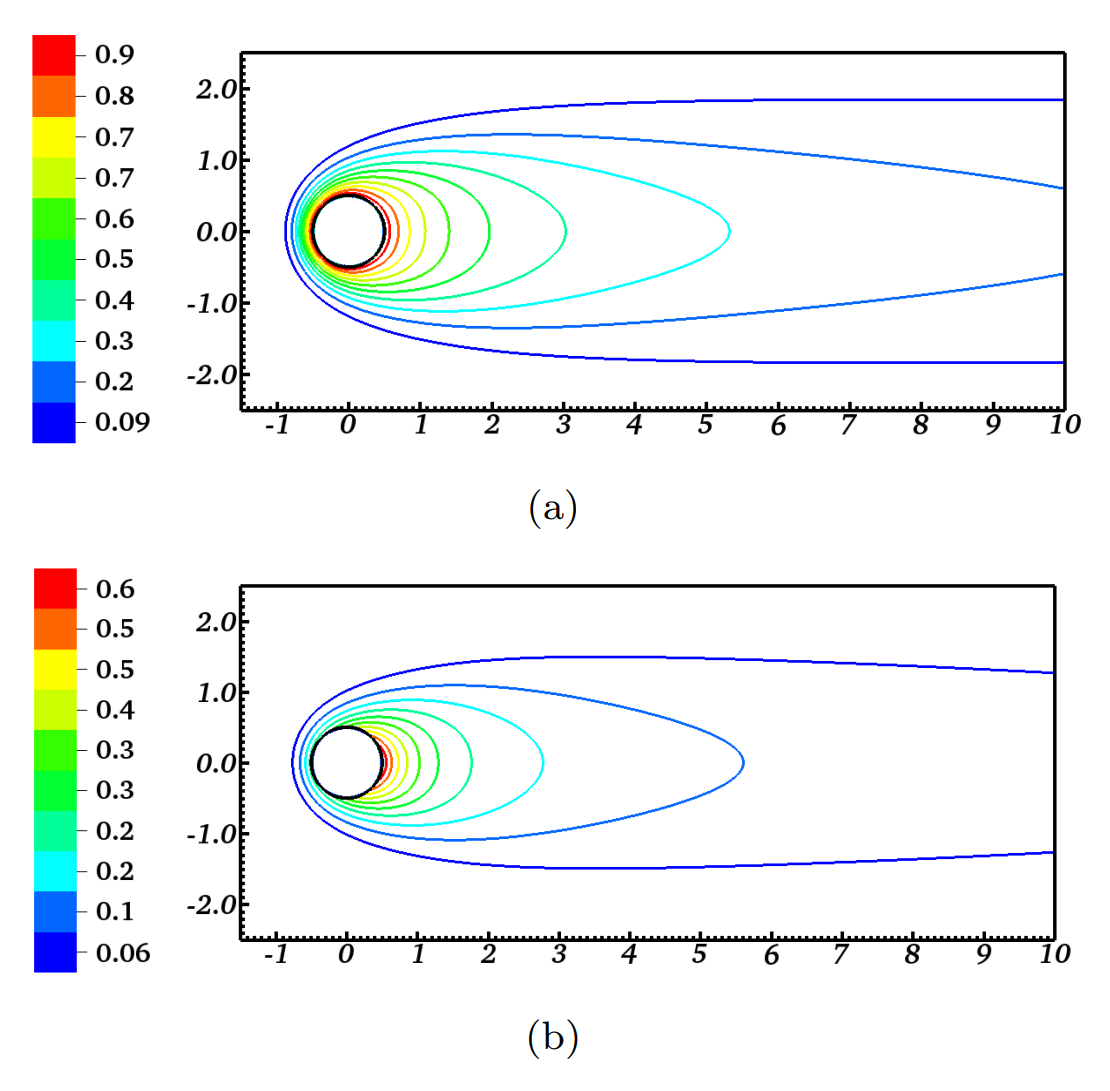
Figure 2 shows the temperature contour lines for both cases.
[1] A. M. D. Jost and S. Glockner, Direct forcing immersed boundary methods: Improvements to the Ghost Node Method, Journal of Computational Physics, volume 438, 110371, 2021.
[2] K. Luo, Z. Zhuang, J. Fan, and N. E. L. Haugen, “A ghost-cell immersed boundary method for simulations of heat transfer in compressible flows under different boundary conditions,” International Journal of Heat and Mass Transfer, vol. 92, pp. 708–717, 2016.
[3] N. Zhang, Z. Zheng, and S. Eckels, “Study of heat-transfer on the surface of a circular cylinder in flow using an immersed-boundary method,” International Journal of Heat and Fluid Flow, vol. 29, no. 6, pp. 1558–1566, 2008.
[4] R. P. Bharti, R. Chhabra, and V. Eswaran, “A numerical study of the steady forced convection heat transfer from an unconfined circular cylinder,” Heat and mass transfer, vol. 43, no. 7, pp. 639–648, 2007.
[5] S. C. R. Dennis, J. Hudson, and N. Smith, “Steady laminar forced convection from a circular cylinder at low reynolds numbers,” The Physics of Fluids, vol. 11, no. 5, pp. 933–940, 1968.
[6] C. Lange, F. Durst, and M. Breuer, “Momentum and heat transfer from cylinders in laminar crossflow,” International Journal of Heat and Mass Transfer, vol. 41, no. 22, pp. 3409–3430, 1998.
[7] A. Soares, J. Ferreira, and R. Chhabra, “Flow and forced convection heat transfer in crossflow of non-newtonian fluids over a circular cylinder,” Industrial & Engineering Chemistry Research, vol. 44, no. 15, pp. 5815–5827, 2005.
[71] R. Ahmad and Z. Qureshi, “Laminar mixed convection from a uniform heat flux horizontal cylinder in a crossflow,” Journal of thermophysics and heat transfer, vol. 6, no. 2, pp. 277–287, 1992.
 1.12.0