
|
0.6.0
|
|
|
0.6.0
|
1D Poisson test cases with Dirichlet boundary conditions
1D Poisson test cases with Dirichlet boundary conditions
This test case solves the pseudo-1D Poisson equation with Dirichlet boundary conditions on 2 opposite boundaries, in a 3D configuration. The aims of this test case are:
Domain is rectangular, its opposite corner coordinates being \((0,0,0)\) and \((1,2,2)\). We solve \(- \Delta T=f\) on the whole domain. 1D solution of the problem is set to \(x^p\). The right-end-side term \( f \) is equal to \(-p(p-1)x^{p-2}\). Figure 1 shows an illustration with \( p=2 \).
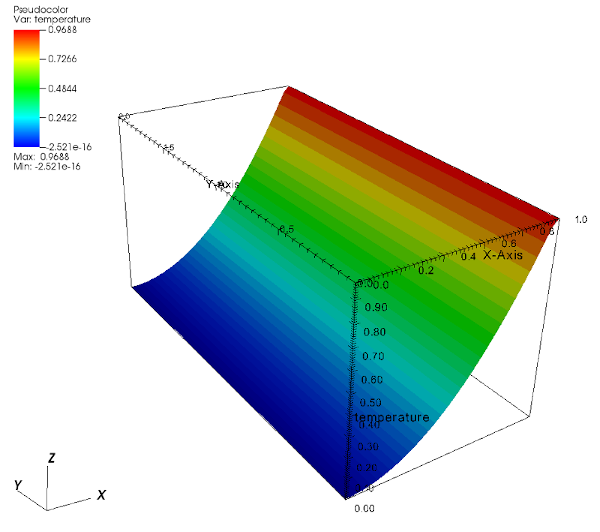
The global boundary conditions are chosen as follows.
| Boundary | Condition | Value |
|---|---|---|
| left | Dirichlet | \( T = 0 \) |
| right | Dirichlet | \( T = 1 \) |
| Other Boundaries | Periodic |
Energy equation is used:
Files test_cases/verification/laplacian/dirichlet_3D_o2.nts and test_cases/verification/laplacian/dirichlet_3D_o4.nts are used to check the convergence as well as to verify the non-regression.
Since the problem is 1D, whatever the direction considered solutions should be equal up to computer precision. This is verified is the validation script of Notus on one mesh.
As regards to spatial convergence, when a centered second order scheme is used to discretize the Laplacian, we expect no error on the solution compared to the quadratic exact solution. This point is achieved only if a quadratic scheme is used to apply the boundary conditions (compared to a linear one).
The case uses diffusion_scheme implicit o2_centered with bc_scheme linear. Second order convergence is observed with \(L_2\), \(L_1\) or \(L_\infty\) norms. The absolute error value is reduced when using quadratic boundary conditions.
bc_scheme quadratic former, the solution is reached up to computer precision whatever the mesh size.| Mesh | Temperature L1 error | order | Temperature L2 error | order | Temperature Linf error | order |
|---|---|---|---|---|---|---|
| 4×4×4 | 0.062499999999999355 | n/a | 0.03124999999999967 | n/a | 0.01562500000000039 | n/a |
| 8×8×8 | 0.0156250000000012 | 2.000 | 0.007812500000000602 | 2.000 | 0.0039062500000101585 | 2.000 |
| 16×16×16 | 0.003906250000004143 | 2.000 | 0.001953125000002072 | 2.000 | 0.0009765625000227734 | 2.000 |
| 32×32×32 | 0.000976562500011836 | 2.000 | 0.0004882812500059154 | 2.000 | 0.000244140625022371 | 2.000 |
| 64×64×64 | 0.000244140625031188 | 2.000 | 0.0001220703125155971 | 2.000 | 6.103515635491608e-05 | 2.000 |
| Mesh | Temperature L1 error | order | Temperature L2 error | order | Temperature Linf error | order |
|---|---|---|---|---|---|---|
| 4×4×4 | 0.020833333333342093 | n/a | 0.010416666666671046 | n/a | 0.00520833333334858 | n/a |
| 8×8×8 | 0.005208333333341572 | 2.000 | 0.002604166666670785 | 2.000 | 0.0013020833333448056 | 2.000 |
| 16×16×16 | 0.0013020833333356285 | 2.000 | 0.0006510416666678146 | 2.000 | 0.000325520833341586 | 2.000 |
| 32×32×32 | 0.00032552083334009413 | 2.000 | 0.00016276041667004696 | 2.000 | 8.138020835524173e-05 | 2.000 |
| 64×64×64 | 8.138020831073147e-05 | 2.000 | 4.0690104155365815e-05 | 2.000 | 2.0345052129264185e-05 | 2.000 |
For this case, we set the power of the solution to \( p=4 \).
The case uses diffusion_scheme implicit o4_centered with bc_scheme linear | quadratic | cubic.
For cubic, fourth order convergence rate of 4 is expected with \(L_2\), \(L_1\) or \(L_\infty\) norms.
A convergence study shows that the global order of accuracy is limited by the lowest-order component: second-order when linear extrapolation is used, third-order with quadratic, and fourth-order only when cubic extrapolation is applied at the boundaries.
Second order convergence is achieved, limited by the lower-order boundary treatment.
| Mesh | Temperature L1 error | order | Temperature L2 error | order | Temperature Linf error | order |
|---|---|---|---|---|---|---|
| 4×4×4 | 0.17154696132596295 | n/a | 0.0994857444352381 | n/a | 0.07822514225197674 | n/a |
| 8×8×8 | 0.04428274428274193 | 1.954 | 0.025690432405141402 | 1.953 | 0.021719769441647552 | 1.849 |
| 16×16×16 | 0.011253030971331495 | 1.976 | 0.00651641566706798 | 1.979 | 0.005711173189485219 | 1.927 |
| 32×32×32 | 0.002836352080065498 | 1.988 | 0.001640244926602669 | 1.990 | 0.001463622061681935 | 1.964 |
| 64×64×64 | 0.0007119875875616106 | 1.994 | 0.0004114156260152842 | 1.995 | 0.00037042629288164264 | 1.982 |
Third order convergence is achieved, limited by the boundary treatment.
| Mesh | Temperature L1 error | order | Temperature L2 error | order | Temperature Linf error | order |
|---|---|---|---|---|---|---|
| 4×4×4 | 0.02792633161511797 | n/a | 0.017629460048572364 | n/a | 0.015079237236130805 | n/a |
| 8×8×8 | 0.00394641723934086 | 2.823 | 0.002410251043293512 | 2.871 | 0.0022211568226787604 | 2.763 |
| 16×16×16 | 0.0005268617059392865 | 2.905 | 0.0003135759694213152 | 2.942 | 0.00029866130003275426 | 2.895 |
| 32×32×32 | 6.811443668498985e-05 | 2.951 | 3.994870491444693e-05 | 2.973 | 3.864620608029501e-05 | 2.950 |
| 64×64×64 | 8.660326340253145e-06 | 2.975 | 5.04008215663929e-06 | 2.987 | 4.9128722333646735e-06 | 2.976 |
Optimal fourth order convergence is achieved, thanks to the high-order boundary treatment.
| Mesh | Temperature L1 error | order | Temperature L2 error | order | Temperature Linf error | order |
|---|---|---|---|---|---|---|
| 4×4×4 | 0.008333333333331364 | n/a | 0.004209782165601088 | n/a | 0.0023838141025644697 | n/a |
| 8×8×8 | 0.0004774477720420164 | 4.125 | 0.00024119064215383573 | 4.125 | 0.0001490926736268962 | 3.999 |
| 16×16×16 | 2.8470564766822627e-05 | 4.068 | 1.433264133987743e-05 | 4.073 | 9.318292277337506e-06 | 4.000 |
| 32×32×32 | 1.7366002492763991e-06 | 4.035 | 8.716854894495194e-07 | 4.039 | 5.823932698246232e-07 | 4.000 |
| 64×64×64 | 1.0719965210775657e-07 | 4.018 | 5.371120622412843e-08 | 4.021 | 3.6399578629483506e-08 | 4.000 |
 1.12.0