
|
0.6.0
|
|
|
0.6.0
|
vof-algebraic test case of single vortex (2D)
vof-algebraic test case of single vortex (2D)
This test case solves advection of a disc of fluid in a sheared analytical velocity field. It is interesting because of the large variation of the interface topology. It is particularly adapted to measure mass-conservation. The objective is to verify the CICSAM advection scheme [1].
The simulation takes place in a 2D box of coordinates \( (0,0) \) and \( (1,1) \). This domain is discretized uniformly with N cells in each directions. A bubble of fluid A is initialized in a domain full of fluid B. The coordinates of the center of the bubble at initial time is \( (0.5,0.75) \) with a \( 0.15m \) radius. The simulation runs during \( T=1.5s \).
The velocity field is inverted at time \( t=T/2 \) such a way to obtain ideally a final state equal to the initial state.
| Time t[s] | \(u(x,y)\) | \(v(x,y)\) |
|---|---|---|
| \( t<0.75s \) | \( 2sin^2(\pi x)cos(\pi y)sin(\pi y) \) | \(-2cos(\pi x)sin(\pi x)sin^2(\pi y)\) |
| \( t>0.75s \) | \( -2sin^2(\pi x)cos(\pi y)sin(\pi y) \) | \(2cos(\pi x)sin(\pi x)sin^2(\pi y)\) |
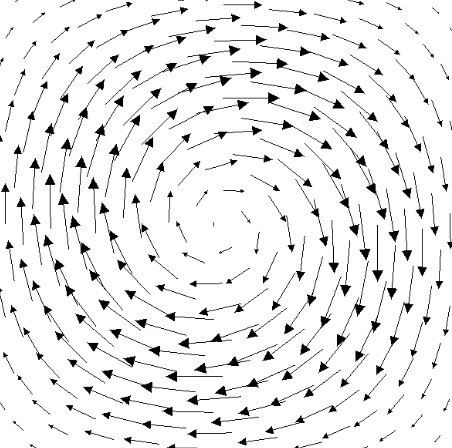
To ensure that CFL of the method is always respected, we set a time step \( \Delta t \) such as
\begin{align} \Delta t = \frac{0.05}{N} \end{align}
In order to evaluate mass loss \( \varepsilon \) during the simulation, we compute the difference between the volume fraction of fluid at initial time and at time T.
\begin{align} \varepsilon = \sum \limits^{N^2}_{i=1}f_i - \sum \limits^{N^2}_{i=1} f_i^0 \end{align}
To evaluate mesh convergence, we define the \( L_1 \) norm of the difference between the initial and the current volume fraction as:
\begin{align} L_1 = \sum \limits^{N^3}_{i=1} |f_i - f^0_i| \\ \end{align}
We also compute local convergence order \( p \) of the method evaluating the evolution of the error with the mesh refinement:
\begin{align} p = \frac{ln\left( \frac{E_2}{E_1} \right)}{ln\left (\frac{N_1}{N_2} \right)} \end{align}
where \( E_1 \) and \(E_2 \) are error for mesh 1 and mesh 2, of size \( N_1\) and \(N_2\) respectively.
The following tables show for different spatial discretization the material loss for the different advection methods.
\begin{align} cicsam method [1] \end{align}
| Grid size N | \( \Delta x \) | \( \varepsilon_{air}\) | \( L_1 \) | p |
|---|---|---|---|---|
| 16 | 1/16 | \( -8.70 \times 10^{-6}\) | \( 2.87 \times 10^{-2}\) | |
| 32 | 1/32 | \( -2.59 \times 10^{-5} \) | \( 7.30 \times 10^{-3}\) | \( 1.97 \) |
| 64 | 1/64 | \( -3.59 \times 10^{-5} \) | \( 2.32 \times 10^{-3}\) | \( 1.65 \) |
| 128 | 1/128 | \( -5.09 \times 10^{-5} \) | \( 1.21 \times 10^{-3}\) | \( 0.93 \) |
| 256 | 1/256 | \( -8.41 \times 10^{-5} \) | \( 6.44 \times 10^{-4}\) | \( 0.92 \) |
| 512 | 1/512 | \( -1.26 \times 10^{-4} \) | \( 3.51 \times 10^{-4}\) | \( 0.87 \) |
\begin{align} mstacs method [2] \end{align}
| Grid size N | \( \Delta x \) | \( \varepsilon_{air}\) | \( L_1 \) | p |
|---|---|---|---|---|
| 16 | 1/16 | \( -9.70 \times 10^{-6}\) | \( 3.54 \times 10^{-2}\) | |
| 32 | 1/32 | \( -2.24 \times 10^{-5} \) | \( 8.15 \times 10^{-3}\) | \( 2.12 \) |
| 64 | 1/64 | \( -3.42 \times 10^{-5} \) | \( 2.10 \times 10^{-3}\) | \( 1.95 \) |
| 128 | 1/128 | \( -5.10 \times 10^{-5} \) | \( 9.00 \times 10^{-4}\) | \( 1.22 \) |
| 256 | 1/256 | \( -8.16 \times 10^{-5} \) | \( 4.68 \times 10^{-4}\) | \( 0.94 \) |
| 512 | 1/512 | \( -1.19 \times 10^{-4} \) | \( 2.41 \times 10^{-4}\) | \( 0.95 \) |
\begin{align} stacs method [3] \end{align}
| Grid size N | \( \Delta x \) | \( \varepsilon_{air}\) | \( L_1 \) | p |
|---|---|---|---|---|
| 16 | 1/16 | \( -5.02 \times 10^{-6}\) | \( 6.49 \times 10^{-2}\) | |
| 32 | 1/32 | \( -1.78 \times 10^{-5} \) | \( 3.87 \times 10^{-2}\) | \( 0.74 \) |
| 64 | 1/64 | \( -3.20 \times 10^{-5} \) | \( 2.05 \times 10^{-2}\) | \( 0.92 \) |
| 128 | 1/128 | \( -5.11 \times 10^{-5} \) | \( 1.20 \times 10^{-2}\) | \( 0.77 \) |
| 256 | 1/256 | \( -8.14 \times 10^{-5} \) | \( 7.18 \times 10^{-3}\) | \( 0.74 \) |
| 512 | 1/512 | \( -1.02 \times 10^{-4} \) | \( 4.59 \times 10^{-3}\) | \( 0.64 \) |
\begin{align} saish method [4] \end{align}
| Grid size N | \( \Delta x \) | \( \varepsilon_{air}\) | \( L_1 \) | p |
|---|---|---|---|---|
| 16 | 1/16 | \( -1.01 \times 10^{-5}\) | \( 3.02 \times 10^{-3}\) | |
| 32 | 1/32 | \( -2.44 \times 10^{-5} \) | \( 6.80 \times 10^{-3}\) | \( 2.15 \) |
| 64 | 1/64 | \( -3.65 \times 10^{-5} \) | \( 1.34 \times 10^{-3}\) | \( 2.33 \) |
| 128 | 1/128 | \( -5.26 \times 10^{-5} \) | \( 5.49 \times 10^{-4}\) | \( 1.29 \) |
| 256 | 1/256 | \( -8.57 \times 10^{-5} \) | \( 2.90 \times 10^{-4}\) | \( 0.92 \) |
| 512 | 1/512 | \( -1.26 \times 10^{-4} \) | \( 1.58 \times 10^{-4}\) | \( 0.87 \) |
The results show that the method is not fully conservative. The different scheme has a first-order convergence and appears more stable when using a large number of cells.
[1] Ubbink, O., & Issa, R. (1999). A Method for Capturing Sharp Fluid Interfaces on Arbitrary Meshes. Journal of Computational Physics, 153(1), 26-50. https://doi.org/https://doi.org/10.1006/jcph.1999.6276 [2] Anghan, C., Bade, M. H., & Banerjee, J. (2021). A modified switching technique for advection and capturing of surfaces. Applied Mathematical Modelling, 92, 349-379. https://doi.org/https://doi.org/10.1016/j.apm.2020.10.038 [3] Darwish, M., & Moukalled, F. (2006). Convective Schemes for Capturing Interfaces of Free Surface Flows on Unstructured Grids. Numerical Heat Transfer, Part B : Fundamentals,49(1), 19-42. https://doi.org/10.1080/10407790500272137 [4] A. Arote, M. B., & Banerjee, J. (2021). An improved compressive volume of fluid scheme for capturing sharp interfaces using hybridization. Numerical Heat Transfer, Part B : Fundamentals, 79(1), 29-53. https://doi.org/10.1080/10407790.2020.1793543
 1.12.0