
|
0.6.0
|
|
|
0.6.0
|
One dimensional diffusion without phase volume variation.
One dimensional diffusion without phase volume variation.
This test case, proposed by [1], aims to validate the implementation of the diffusion flux in the species conservation equation. It thus provides a simplified framework for verifying the model’s ability to accurately capture the discontinuity of the concentration field at the interface, in the absence of flow and any volume variation induced by mass transfer.
The problem under consideration involves a stationary interface separating a gaseous phase \(\alpha_g = 1\) from a liquid phase \(\alpha_l = 1 \). Each of these phases is composed of two chemical species: \(A\) and \(B\) in the gas phase, and \(A\) and \(C\) in the liquid phase. Since species \(B\) and \(C\) are respectively insoluble in the liquid and gas phases, only species \(A\), diluted in both phases, is subject to diffusion.
The objective of this test case is therefore to numerically investigate the diffusion of species \(A\) in this two-phase system and to compare the obtained results with a reference analytical solution.
The simulation take places in a 2D box of total length \(L = 2 \times l_I \) and height \(H = l_I \), where \(l_I \) denotes the position of the stationary interface separating the two fluids at rest. The liquid phase occupies the left part of the domain \(0 \leq x \leq l_I \), while the gas phase is located in the right part \( l_I \leq x \leq L \).
The diffusion coefficients of species \(A \) in the two phases, denoted \(D_{A,g} \) and \(D_{A,l} \), are chosen such that their ratio is fixed at \(\frac{D_{A,g}}{D_{A,l}} = 10 \).
The initial conditions impose a zero concentration in the liquid phase \(\rho_{A,l}^0 = 0\) and a unit concentration in the gas phase \(\rho_{A,g}^0 = 1 \). These values are maintained over time through Dirichlet boundary conditions applied respectively at \(x = 0\) (liquid side) and at \(x = L\) (gas side).
The results are shown in Figure 1.
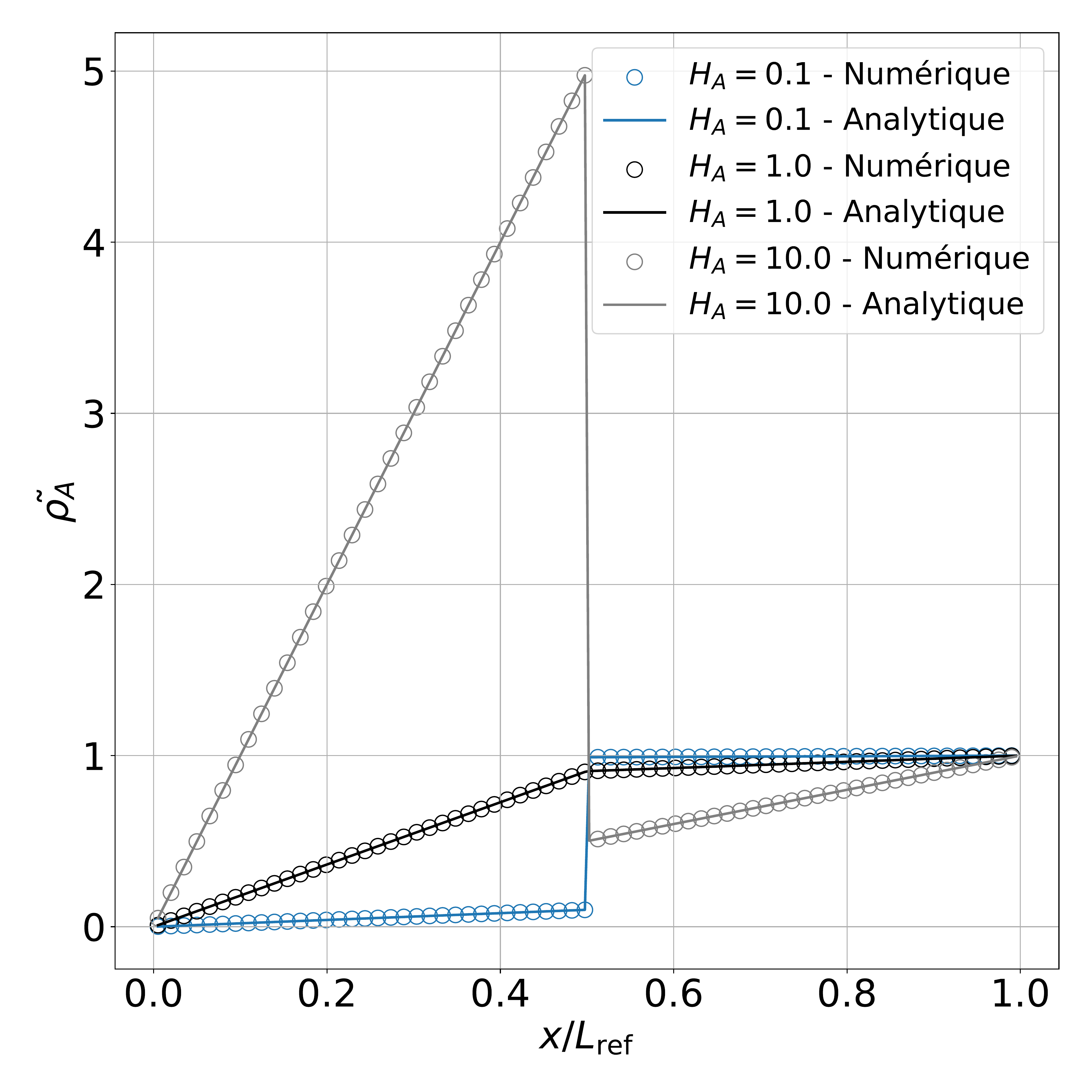
The obtained results show an excellent agreement between the numerical solution and the analytical profiles, regardless of the value of \(H_A \).
[1] Haroun, Legendre, D., & Raynal, L. (2010b). Volume of fluid method for interfacial reactive mass transfer : Application to stable liquid film. Chemical Engineering Science, 65, 2896-2909. https://doi.org/10.1016/j.ces.2010.01.012
 1.12.0