|
0.6.0
|
|
|
0.6.0
|
Stencil for cell-based schemes. More...
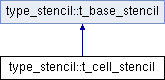
 Inheritance diagram for type_stencil::t_cell_stencil:
Public Attributes | |
| integer, dimension(:,:,:), allocatable | c |
Maps a relative cell offset (u,v,w) to its relative matrix index. | |
| type(t_serialized_stencil), dimension(:), allocatable | s |
| Inverse stencil mapping. | |
| Public Attributes inherited from type_stencil::t_stencil | |
| type(t_string) | label |
| User-defined stencil label. | |
| integer | size = 0 |
| Number of terms in the stencil. | |
| integer | extent = huge(1) |
| Maximum stencil offset in the infinity norm. | |
Stencil for cell-based schemes.
| integer, dimension(:,:,:), allocatable type_stencil::t_cell_stencil::c |
Maps a relative cell offset (u,v,w) to its relative matrix index.
Example: The diagonal coefficient of cell (i,j,k) is stored at diag = (ls_mapl(i,j,k) - 1) * stencilsize. The coefficient corresponding to the neighbor (1,0,0) is stored at diag + stencilc(1,0,0).
| type(t_serialized_stencil), dimension(:), allocatable type_stencil::t_cell_stencil::s |
Inverse stencil mapping.
For each relative matrix index (column) n, stencils(n) stores the corresponding cell offset (i,j,k) together with the associated linear memory offset.
This representation is convenient when exporting the matrix to other storage formats (IJK, CSR, etc.).
 1.12.0